If you’ve spent any time on social media lately, you’ve likely seen the viral videos of 20-year-old “gurus” showing off their sports cars and claiming they made $50,000 in their first month of dropshipping. They make it sound effortless: find a product on AliExpress, build a Shopify store, run some TikTok ads, and watch the cash roll in.
But here is the cold, hard economic reality that those gurus won’t tell you: in 2026, the dropshipping landscape has fundamentally changed. The era of the “general store” selling cheap plastic trinkets with 4-week shipping times is dead [1]. Today, standard e-commerce startup costs can easily spiral out of control. Many blogs claim you need a massive budget of $3,500 to $8,000 just to test a single product over three months due to rising platform fees and paid advertising costs [2].
But as an economist who specializes in lean startup principles, I refuse to accept that entry barrier [3]. That’s why I wrote the budget-friendly guide for marketing earlier this month here on PennyPencil.
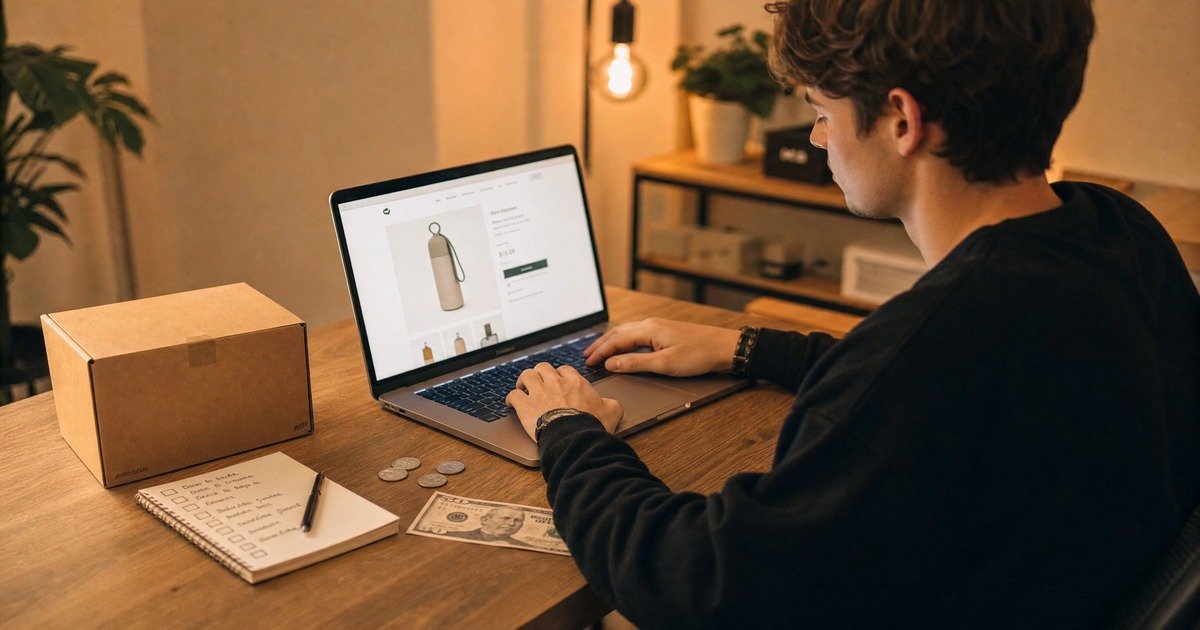
You do not need thousands of dollars to build a highly professional, profitable e-commerce brand. By ruthlessly focusing on a highly specific, passionate micro-niche and leveraging organic social media, you can build and launch a fully functional dropshipping store for exactly $45 [1].
Here is my exact, battle-tested 7-day checklist to launch your own frugal e-commerce brand on a shoestring budget. And before you do…take 30 minutes to stress test your business idea with ChatGPT.
The $45 Budget Breakdown
Before we dive into the daily checklist, let’s look at where every single dollar of our $45 budget is going:
- Shopify Starter Plan (Month 1): $5.00 (Shopify regularly runs $1 or $5 promotional trials for the first month) [4].
- Custom Domain (.com): $14.00 (Purchased directly through Namecheap or Porkbun).
- AutoDS / Spocket Subscription (Trial): $0.00 (Using 14-day free trials to source products).
- TikTok / Instagram Business Accounts: $0.00 (Completely free to set up).
- Canva Free Tier (For Branding): $0.00 (For logo and social media graphics).
- Micro-Influencer Product Sample: $26.00 (Buying 2 samples of your product to film custom video content).
- TOTAL COST: $45.00
The 7-Day Launch Checklist
+-------------------------------------------------------------------------+
|                        7-DAY LAUNCH ROADMAP                             |
+-------------------------------------------------------------------------+
|  Day 1: Micro-Niche Selection & Product Sourcing                        |
|  Day 2: Secure the Domain & Brand Identity                              |
|  Day 3: Build the High-Converting Landing Page                          |
|  Day 4: Order Samples & Set Up Logistics                                |
|  Day 5: Set Up Free Organic Social Funnels                              |
|  Day 6: Film Custom Content & Outreach to Micro-Influencers             |
|  Day 7: Launch, Analyze, and Iterate                                    |
+-------------------------------------------------------------------------+
Day 1: Micro-Niche Selection & Product Sourcing
The biggest mistake beginners make is trying to sell everything to everyone. To succeed on a budget, you must find a highly passionate, specific micro-niche.
* The Goal: Find an audience that is obsessed with a specific hobby, lifestyle, or problem (e.g., “ergonomic accessories for remote writers” or “vintage-style leather journals for travelers”).
* Action Item: Use TikTok Search and Google Trends to find products with high engagement and emotional appeal. Use sourcing platforms like Spocket or AutoDS to find US-based suppliers who can guarantee 3-to-5 day shipping times [1]. Avoid suppliers with 20-day shipping; in 2026, customers expect speed [1].
Day 2: Secure the Domain & Brand Identity
Your store must look like a high-end boutique, not a cheap dropshipping site.
* The Goal: Establish trust and authority through clean, minimal branding.
* Action Item: Buy a custom .com domain (e.g., www.thefrugalwriter.com) for $14 [1]. Use Canva to design a clean, text-only logo. Stick to a simple two-color palette (e.g., forest green and cream) to maintain an editorial, high-end feel.
Day 3: Build the High-Converting Landing Page
You do not need a complicated, multi-page website. A single, highly optimized product landing page is far more effective at converting traffic.
* The Goal: Build a mobile-first, fast-loading store that clearly explains the product’s benefits.
* Action Item: Set up your Shopify store using the $5 Starter Plan [4]. Choose a clean, free theme like Dawn. Write a compelling product description focused on benefits rather than features, and include high-quality images and a clear FAQ section.
Day 4: Order Samples & Set Up Logistics
You cannot market a product you have never held in your hands.
* The Goal: Verify product quality, test shipping speeds, and secure assets for content creation.
* Action Item: Order two samples of your product from your supplier (budget: $26) [1]. One sample is for you to film custom marketing videos; the other will be shipped directly to a micro-influencer.
Day 5: Set Up Free Organic Social Funnels
Paid Facebook and Google ads are a money-pit for beginners. In 2026, organic short-form video (TikTok, Instagram Reels, YouTube Shorts) is the ultimate free traffic driver.
* The Goal: Build the digital pathways that will funnel free traffic to your store.
* Action Item: Create dedicated TikTok, Instagram, and Pinterest business accounts for your brand. Optimize your bios with a clear hook (e.g., “Helping remote writers eliminate wrist pain. 💻”), and place your Shopify link in the bio.
Day 6: Film Custom Content & Outreach
Once your samples arrive, it is time to manufacture attention.
* The Goal: Create high-converting, organic video assets and leverage micro-influencers.
* Action Item: Film 5–10 short-form videos showing your product in action. Focus on “problem vs. solution” framing. Additionally, find 5 micro-influencers in your niche (under 10,000 followers) and offer to send them your second free sample in exchange for an honest video review.
Day 7: Launch, Analyze, and Iterate
Your store is live, your funnels are built, and your content is ready to post.
* The Goal: Publish your assets, track traffic, and analyze user behavior.
* Action Item: Post 3 short-form videos per day across TikTok, Reels, and Shorts. Monitor your Shopify analytics. If you are getting traffic but no sales, your pricing or product description is the issue. If you are getting no traffic, your video hooks need to be more engaging.
The Economist’s Verdict: Focus on Velocity over Capital
In my writing, I always remind entrepreneurs that capital is not a substitute for creativity [3].
Many founders fail because they spend $5,000 building a perfect store before validating if anyone actually wants the product [3]. By using this frugal $45 checklist, you limit your financial risk to the price of a dinner out [1].
If the product fails to gain traction after 7 days of organic posting, you can shut down the store, pivot to a new micro-niche, and try again next week [1]. This is how you win in the modern economy: by learning fast, staying lean, and protecting your capital [1] [3].
References
- [1] Jared Marino. “The Frugal Entrepreneur’s Guide to Starting a Business.” Penny Pencil, November 26, 2025. https://pennypencil.com/frugal-entrepreneurs-guide-to-starting-a-business/
- [2] ShiptoTheMoon Logistics. “Dropshipping Startup Cost in 2026: Real 3-Month Budget Breakdown.” ShiptoTheMoon Blog, March 27, 2026. https://www.shiptothemoon.com/dropshipping-startup-costs-breakdown/
- [3] Jared Marino. “Jared Marino — Professional Bio.” Claros Academy / WordPress, June 3, 2026. https://marinoblogroll.wordpress.com/
- [4] Printify Sourcing. “How Much Does It Cost to Start Dropshipping in 2026.” Printify Blog, February 10, 2026. https://printify.com/blog/how-much-does-it-cost-to-start-dropshipping/