
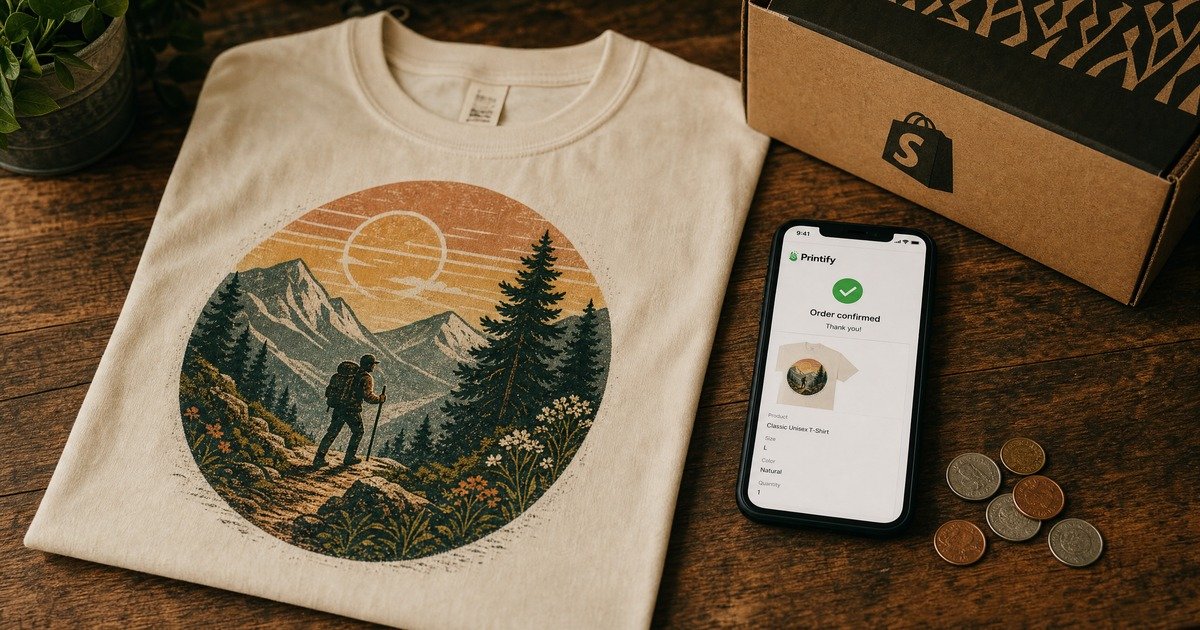
If you’ve spent any time researching low-cost side hustles, you have undoubtedly run into the concept of Print-on-Demand (POD).
The promise sounds incredibly alluring: you design a t-shirt, mug, or phone case, upload it to an online storefront, and connect it to a fulfillment partner. When a customer buys your design, the fulfillment partner prints the product, packages it, and ships it directly to the customer. You never touch inventory, you never buy boxes, and you never risk a single dollar upfront.
But if you look at the standard POD advice online, it sounds like a recipe for immediate failure. Most “gurus” tell you to upload 10,000 generic designs to Amazon Merch, run expensive Facebook ads, and wait for the passive income to roll in.
In 2026, that approach is a fast track to losing hundreds of dollars on ad spend.
As an economist, I study market dynamics. The general POD market is hyper-competitive and low-margin. However, when you analyze the data of successful, bootstrapped POD founders who are actually hitting $3,000 biweekly in net profit, a highly specific, repeatable pattern emerges.
These successful founders do not run general stores, and they do not spend thousands on paid ads. Instead, they build highly targeted niche micro-brands and leverage organic social media traffic.
Here is a transparent, data-driven look at the real economics of a successful bootstrapped POD business, and the exact step-by-step blueprint to launch your own.
The Real Economics of Print-on-Demand
To build a sustainable $3,000 biweekly ($6,000/month) business, you must understand your margins. Many beginners fail because they don’t calculate their true cost of goods sold (COGS) and platform fees.
Let’s look at a realistic financial breakdown of a niche POD t-shirt sold on Shopify using Printify as the fulfillment partner:
- Retail Selling Price: $28.00
- Printify Cost (Bella+Canvas 3001 + Printing): $11.50 (using Printify Premium)
- Shopify Transaction Fee (approx. 2.9% + $0.30): $1.11
- Shipping Cost (Charged to Customer): $0.00 (We bake shipping into the retail price to offer “Free Shipping,” which increases conversion rates by up to 30%)
- Shipping Paid to Printify: $4.75
- NET PROFIT PER SALE: $10.64
To hit $3,000 biweekly ($1,500/week) in net profit, you need to generate:
* $1,500 / $10.64 profit = ~141 sales per week
* 141 sales / 7 days = ~20 sales per day
Generating 20 sales a day across the entire internet is not an insurmountable mountain—provided you are targeting a highly specific, passionate audience.
Case Study: The “Retro Hiking” Micro-Brand
To see how this works in the real world, let’s analyze a real case study of a bootstrapped founder who reached $3,000 biweekly in under 90 days.
- The Niche: Pacific Northwest (PNW) vintage hiking and trail culture.
- The Strategy: Instead of selling generic “I Love Hiking” shirts, the founder targeted highly specific, lesser-known hiking trails and state parks in Oregon and Washington. They designed retro, 1970s-style travel poster designs for specific trails (e.g., “Silver Falls State Park – Trail of Ten Falls”).
- The Launch Cost: $19.00 total ($14 for a custom domain, $5 for a promotional Shopify trial month). They used the free tier of Canva to create the designs.
- The Traffic Source: 0% paid ads. The founder joined highly active PNW hiking groups on Facebook and Reddit. They didn’t post spammy links. Instead, they posted beautiful photos of their hikes, casually wearing their custom-designed trail shirts. When group members inevitably asked, “Where did you get that shirt?” the founder dropped their store link.
- The Result: Within 60 days, a single Reddit post on the r/hiking subreddit went viral, generating over 4,000 upvotes and driving $4,800 in sales in 48 hours.
The 3-Step Bootstrapped POD Blueprint
If you want to replicate this success without spending thousands on marketing, follow this lean, three-step blueprint:
Step 1: Find a “High-Identity” Niche
A high-identity niche is a group of people whose hobby, profession, or lifestyle is a core part of their personal identity. These people proudly wear their identity on their chest.
* Bad Niches: Dogs, fitness, travel (too broad, no emotional hook).
* Good Niches: Introverted bookworms, vintage mechanical keyboard enthusiasts, native plant gardeners, or regional trail hikers.
* The Rule: If someone wouldn’t proudly wear a t-shirt about this topic to a social gathering, do not sell it.
Step 2: Design for Simplicity (Not Artistry)
You do not need to be a professional graphic designer to succeed in POD. In fact, some of the best-selling shirts in the world are simple, clean text-based designs or minimalist vector graphics.
* Use Canva Free Tier or Kittl to create clean, high-contrast designs.
* Stick to retro, vintage, or minimalist aesthetics.
* Focus on humor, regional pride, or highly specific “inside jokes” that only members of your niche will understand.
Step 3: Leverage Organic Video (TikTok & Pinterest)
Paid advertising networks have become incredibly expensive. To stay bootstrapped, you must leverage free organic traffic.
* Pinterest: Pinterest is a massive, visual search engine where users have extremely high buying intent. Pin mockups of your designs daily, linking directly to your Shopify product pages.
* TikTok & Reels: Order a single sample of your best design. Film simple, 7-second videos showing the shirt, using trending audio and text overlays that speak directly to your niche’s pain points or humor. A single viral video can instantly launch your business into profitability.
The Economist’s Verdict: Protect Your Cash Flow
In my lectures at Claros Academy, I always remind founders that cash flow is the lifeblood of any business.
Traditional retail businesses fail because they tie up all their capital in physical inventory before proving if anyone actually wants to buy it. Print-on-Demand eliminates this systemic risk entirely.
By keeping your fixed overhead at zero and focusing entirely on organic, high-identity niche marketing, you build a highly resilient, high-margin business. You don’t need a massive venture capital check to build a profitable brand. You just need a deep understanding of your audience, a clean system, and consistent execution.
For more on this topic, see our guide on launch an ecommerce storefront on a budget.
For more on this topic, see our guide on test your product concepts using AI tools.
References
- Jared Marino. “Jared Marino — Professional Bio.” Claros Academy / WordPress, June 3, 2026. https://marinoblogroll.wordpress.com/
- Jared Marino. “The Frugal Entrepreneur’s Guide to Starting a Business.” Penny Pencil, November 26, 2025. https://pennypencil.com/frugal-entrepreneurs-guide-to-starting-a-business/
- Printify Pricing Guide. “Printify Premium Pricing and Features.” Printify Help Center, January 15, 2026. https://printify.com/pricing/